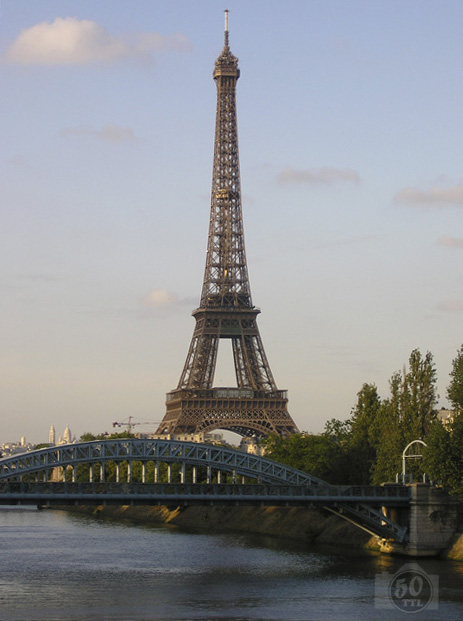
Marg and I were fortunate enough to be able to travel overseas in 2004, visiting Japan, Denmark and France. It was the first time I had been out of the country since 1977. I decided that the old Olympus OM-1, which had accompanied me on that 1977 trip, was past its use-by and it was finally time to go digital. For my first venture into digital photography, I bought a small point-and-shoot Olympus that produced a 3.2 megapixel image.
It was a start. I got reasonable photos that would have printed well enough at the usual printshop size. Like any tourist, I took postcard-like photos such as the Eiffel Tower above. It had a tiny optical viewfinder and I didn’t like using the rear screen to compose a photo, having been so used to the OM1’s bright viewfinder. I use reading glasses, and having to compose and check focus on a rear screen meant I would constantly put on the glasses to check the screen, then take them off again to look at the real world. Often, I would go without and frame a photo without quite having clear vision. Sometimes, I would be disappointed in the result, which may have autofocused on the wrong part of the image.
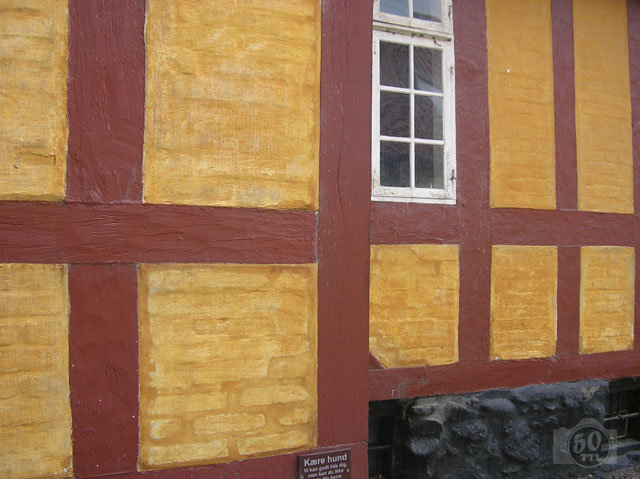
However, I also started changing my film-based mindset. I began taking pictures just because I could. This photo was taken just because we liked the colours used in the houses in Denmark. The digital camera enabled me to take dozens of photos instead of being selective because of the cost of film.
For those too young to know, or those with short memories, I recall that some constraints still applied. There was a transition period in the move to digital when you couldn’t just shoot huge numbers of photos, because you would fill up memory cards pretty quickly (the ones I could afford, anyway). When I travelled, I did not take a laptop with me and I don’t think there was any such thing as cloud storage, so I had to find shops offering digital transfer services. I came home with CDs of images taken on my travels. I had to wait until I got back to my home computer before I could look at the shots and sort through them. It was a little bit like the film days when you had to wait for the photo lab to process your slides and post them back to you.
Some photographers still sneer at digital and pine for the ‘purer’ photography delivered by film. I disagree. Back in the 1970s, before digital photography was a significant possibility, Susan Sontag described how the then modern state of photography and its ‘present mood of doubt’ created nostalgia for a purer past. “This nostalgia for some pristine state of the photographic enterprise underlies the current enthusiasm for daguerreotypes, stereograph cards, photographic cartes de visite, family snapshots, the work of forgotten nineteenth- and early-twentieth-century provincial and commercial photographers.” So apparently there was nostalgia for a previous past in the 1970s, and today’s nostalgia for film probably draws from the same well.
Digital cameras offer so much to photographers. The quality of the image is now superior, and the convenience and control are vastly better. About the only nitpicking observation I would make is that film produced better bokeh. In my hands at least, digital images seem to have visible edges to bokeh whereas the film transitions were seamless.